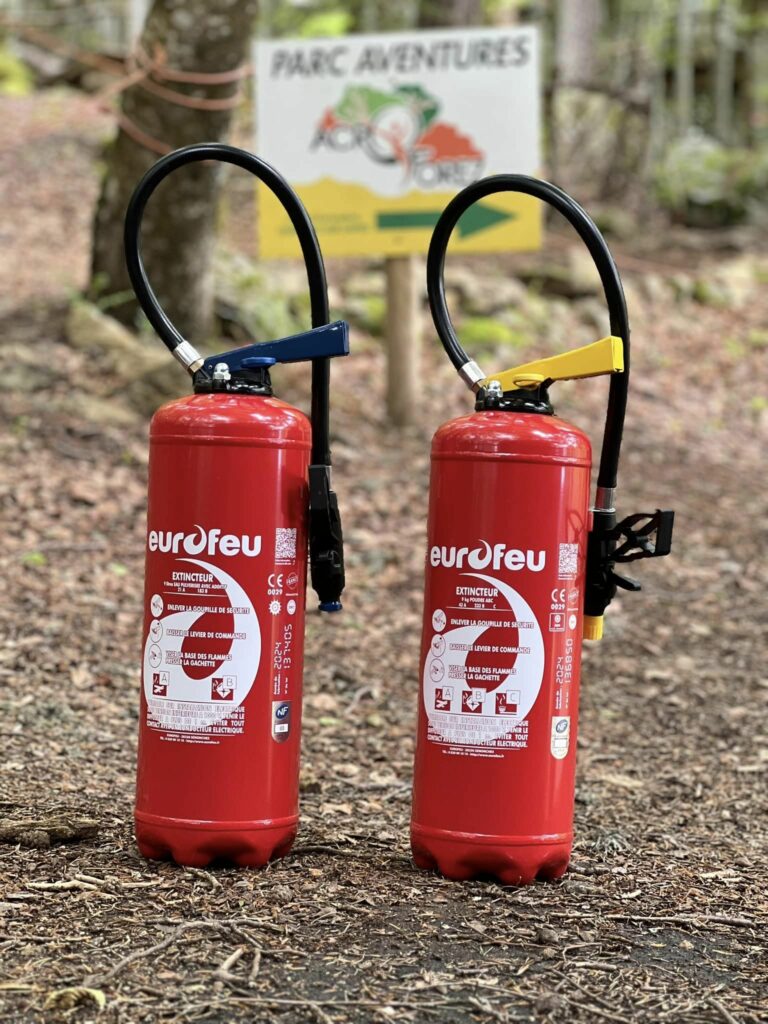

Foam or powder extinguisher?

Foam or powder fire extinguisher: Which choice for your safety?
Choosing between a foam extinguisher and a powder extinguisher depends on a number of factors, including the type of fire you might encounter, the environment in which it will be used, and your cleaning and safety preferences. Here's a guide to help you understand the differences and make the right choice.
When should you use a foam extinguisher?
Description :
A foam extinguisher (terminology used in Belgium) is a type of water-based extinguisher with an additive. The term "foam" refers to the physical form of the agent projected onto a fire: it forms a floating foam. The addition of air creates an emulsifying agent that optimizes the foam's effectiveness.
- Extinguishing agent: Foam forming a barrier against oxygen, thus smothering flames. The water content also acts as a cooling agent on Class A fuels.
- Fire types: Class A (solid materials such as wood, paper and textiles) and Class B (flammable liquids such as petrol, oils and solvents).
Advantages :
- Effectiveness: Highly effective for Class B fires, i.e. flammable liquids, forming a barrier that prevents vapors from escaping.
- Residue: Less residue and cleaning than powder, making it more suitable for clean environments.
- Safety: less irritating to the respiratory tract than powder. Today, there are fire extinguishers with fluorine-free additives (PFAS) that are more respectful of the environment and users' health.
Disadvantages :
- Limitations : Not suitable for Class C fires (gases) and Class D fires (metals). May conduct electricity, so use with caution near live electrical equipment.
- Maintenance: May require more frequent maintenance to ensure foam remains effective.
Ideal for: Kitchens, offices, garages, and places where flammable liquid fires are a possibility but clean-up is a concern.
Why use a dry powder extinguisher?
Description :
- Extinguishing agent: Chemical powder that acts by suffocation.
- Fire types: Versatile for Class A, B and C fires (flammable gases such as propane and butane).
Advantages :
- Versatility: Efficient on a wide range of fire types, including Class C (gas).
- Effectiveness: Fast and effective in extinguishing intense flames.
- Shelf life: Long shelf life and less risk of loss of efficacy.
Disadvantages :
- Residue: Leaves a fine powder that can be messy and require extensive cleaning.
- Irritation: May irritate respiratory tract and eyes.
- Corrosion: Powder can damage sensitive electronic equipment.
Ideal for : Garages, workshops, warehouses, and places where various types of fire can occur.
Comparison of uses
| Features | Foam extinguisher | Powder extinguisher |
|---|---|---|
| Efficiency | Class A and B lights | Class A, B and C lights |
| Residues | Less residue | Large powder residues |
| Security | Less irritating, but use with care near electrical appliances | May irritate the respiratory tract and damage electronics |
| Maintenance | Requires regular maintenance | Long shelf life |
| Environments | Ideal for clean environments where flammable liquids are present | Ideal for industrial and mixed environments |
Conclusion
The choice between foam and powder extinguishers depends on your specific needs:
- Foam extinguisher: Ideal for environments where flammable liquid fires are a concern and clean-up after use is important, such as kitchens and offices.
- Powder extinguisher: Versatile and effective for a wide range of fires, particularly suitable for garages, workshops and industrial environments.
Article écrit par le service expertise Eurofeu