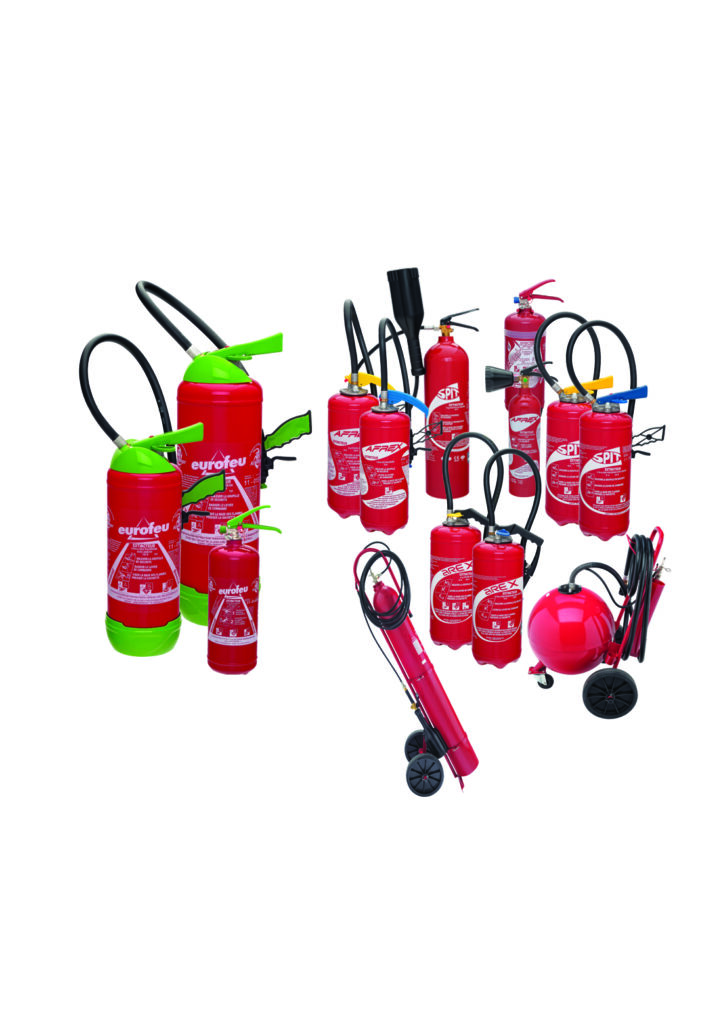

What are the 3 types of extinguisher?

A fire extinguisher is a pressurized (auxiliary or permanent) first-response device designed to spray a suitable extinguishing agent onto an identified class of fire. There are 3 to 4 different types of extinguisher for the most common types of fire.
What are the 4 main classes of fire?
The first step is to understand the types of fire you may encounter. There are 4 to 6 common classes of fire:
- Class A: Fires involving solid materials such as wood, paper and textiles.
- Class B: Fires involving flammable liquids such as petrol, oil and paint.
- Class C: Fires involving flammable gases such as propane and butane.
- Class D: Combustible metal fires such as magnesium and sodium.
- Class F: Cooking oil and grease fires.
- Lithium-Ion battery fires: a new class of fire is being created.
2. How many types of extinguisher are there?
In France, there are 3 or 4 different types of extinguisher for these types of fire: pure water, water spray with additives (also known as foam extinguishers), powder (ABC, BC or D powder) and CO2. Each extinguishing agent has its own advantages and disadvantages when it comes to dealing with one or more classes of fire.
The four main types of extinguisher are :
Water extinguisher :
- Use: Ideal for Class A fires.
- Advantages: Efficient and easy to use.
- Disadvantages : Do not use on electrical fires or flammable liquids.
Water spray extinguishers with additive :
- Use: Effective on class A, B or F fires with the appropriate additive (such as Eurofeu ecological additive).
- Advantages: Effective on flammable liquids and solids. The additive contained in the extinguisher provides improved wetting power on Class A and surfactant power on Class B fires to block the oxygen supply.
- Disadvantages : Do not use on gas or electric fires.
Powder extinguisher :
- The ABC powder extinguisher is the most common: versatile, capable of extinguishing Class A (solid materials), Class B (flammable liquids) and Class C (flammable gases) fires.
- A specific powder for Class D fires is available for use on this type of fire.
- Advantages: Versatile and effective on various types of fire.
- Disadvantages: Can cause damage and leave powder residue.
CO2 (Carbon Dioxide) extinguisher :
- Use: Ideal for Class B and electrical fires.
- Advantages: Leaves no residue, perfect for electronic equipment.
- Disadvantages: Less effective on Class A fires, limited discharge time.
These three types cover a wide range of applications and are selected according to the type of fire expected in the environment where they will be used.