
FIRE HYDRANTS
What is a fire hydrant?
A fire hydrant is an above-ground water intake connected to a pressurized water network. It enables emergency services to quickly connect their equipment, such as fire trucks. Fire hydrants are used for fire-fighting and public drinking water supply (irrigation, industry, etc.).
The installations are located close to the roadway, so as to remain accessible at all times.
The fire hydrant is a device belonging to the group of Fire Water Points (FWP).
You need personalized support
Our teams are at your disposal to answer any questions you may have.
How does a fire hydrant work?
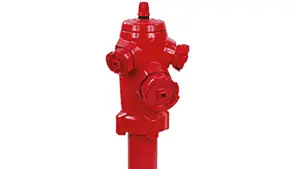
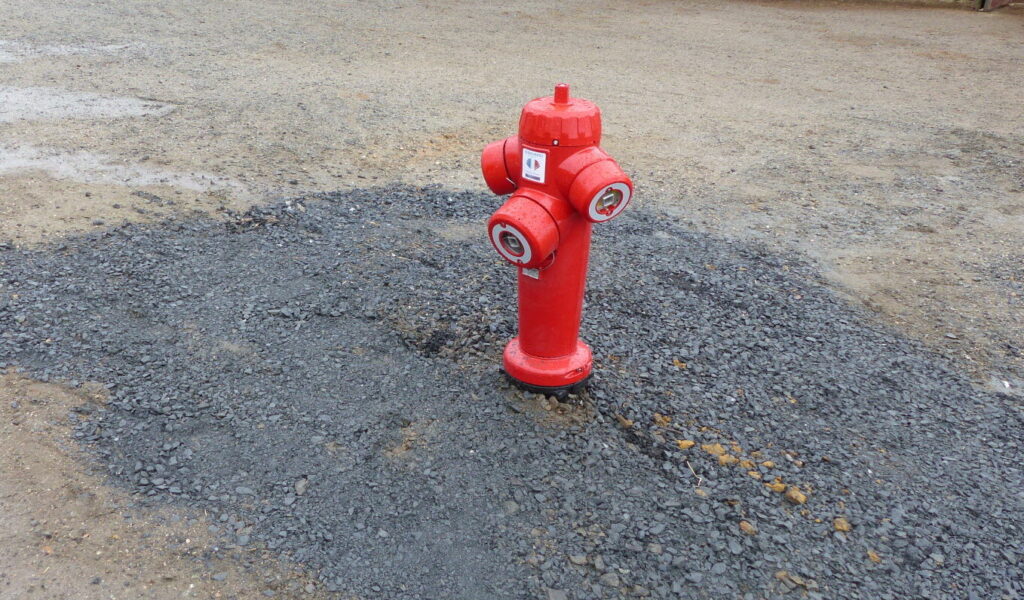
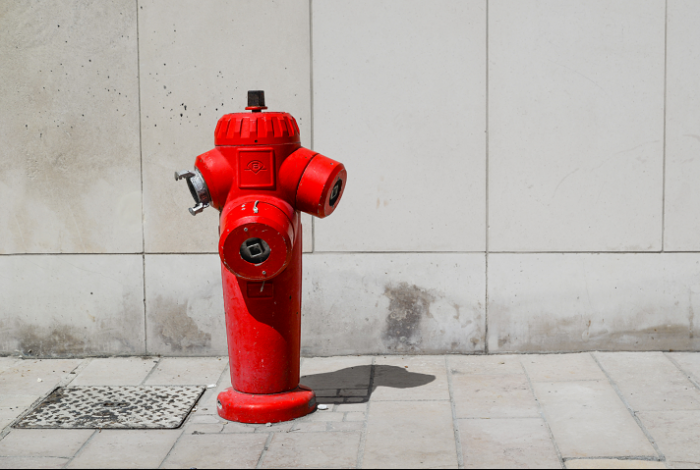
The fire hydrant is a small, cast-iron column, about one meter high and red in color. It has three symmetrical outlets for connecting hoses, closed by plugs.
To open the outlets, a standard 3 cm manoeuvring square is fitted to the head of the fire hydrant.
The water is released slowly and progressively by rotating the square spindle, so as not to cause excessive water inrush, which could damage the pipes or destabilize the system.
What's the difference between a hydrant and a fire hydrant?
A hydrant and a hydrant pole have the same function: they provide firefighters with a large reserve of pressurized water to fight a fire. However, the hydrant's plugs protrude from the ground. The pole is red and visible to all. The hydrant is buried and the connection is made at ground level.
FAQ
What's the difference between a reversible and a non-reversible fire hydrant?
The non-reversible post has a single-part mechanism. The flap is controlled directly by the post's operating square. The non-overturnable model withstands a 30-tonne impact, making breakage unlikely in the event of vehicle impact. As a precautionary measure, however, non-overturnable posts are used in
low-traffic areas or areas away from traffic lanes, to avoid creating overly sturdy obstacles close to roadways.
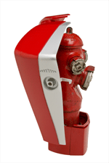
The tiltable post features a two-part flap opening mechanism linked by a safety system. In the event of an impact weighing more than 2 tonnes, the safety system breaks to release the upper part of the pole, which tips over without causing water leakage or irreparable damage to the structure. Reversible poles are recommended when installed near traffic routes.
How to check a fire hydrant
To ensure the continued availability of a
hydrant installation, regular inspection and maintenance must be carried out in accordance with
norme NFS 62 200. The following points must be checked:
- Visual inspection and accessibility,
- Check hydrant numbering,
- Check pressure,
- Check flow rate at 1 bar pressure (e.g. 60 m3 / h for 1 DN100),
- Check seal tightness,
- Check and maintain proper drain operation,
- Condition and presence of valves and fittings,
- Condition of casing.
Need help?
Contact our teams for a precise diagnosis.